AskLivermore Review: Honest Stock Scanner Assessment for 2026 Trading
Traders waste countless hours scrolling through hundreds of charts, hoping to spot quality setups before they disappear. Traditional screeners dump raw data without context. Pattern recognition tools often flag every minor formation, creating noise instead of clarity.
The explosion of retail trading platforms has created a scanner arms race. Everyone promises the "ultimate" tool, but most deliver either overwhelming complexity or oversimplified metrics. Finding a scanner that actually improves your hit rate — not just your screen time — remains surprisingly difficult.
Pattern Detection vs. Traditional Screening
Most stock screeners focus on fundamental and technical metrics: P/E ratios, RSI levels, volume spikes. They excel at filtering large universes down to manageable lists. But they don't tell traders why a stock matters or when to act.
Pattern recognition scanners take a different approach. They identify specific chart formations that historically lead to predictable price moves. Instead of sorting by arbitrary metrics, they highlight setups with statistical edges.
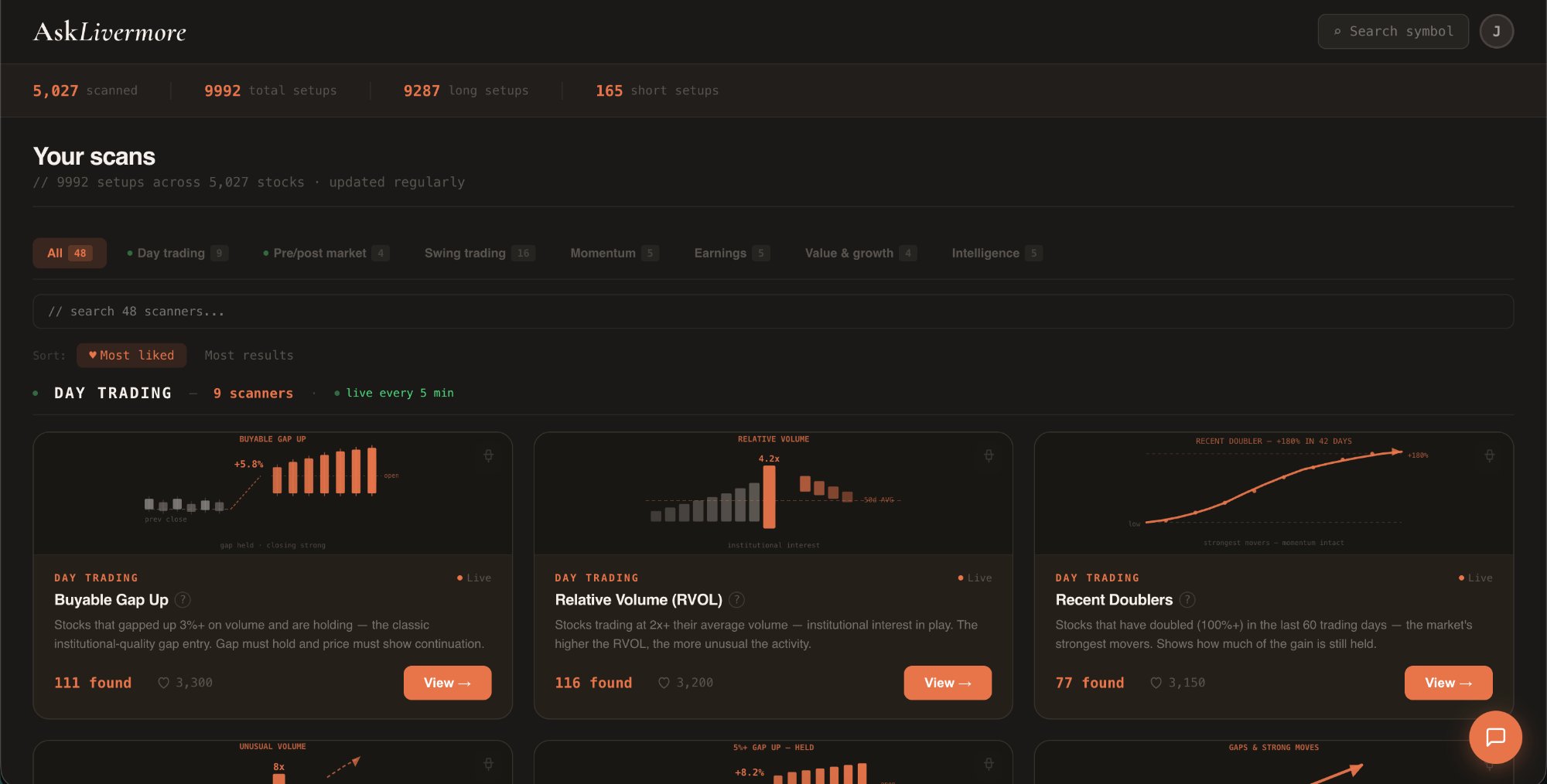
AskLivermore fits squarely in the pattern detection camp. Its 48 scanners across 7 categories focus on identifying formations like bull flags, VCP bases, and cup and handles rather than filtering by traditional metrics.
The trade-off is philosophical. Traditional screeners cast wider nets but require more analysis. Pattern scanners do more upfront work but surface fewer, higher-probability opportunities.
AskLivermore's Grading System: A+ to B Quality Scoring
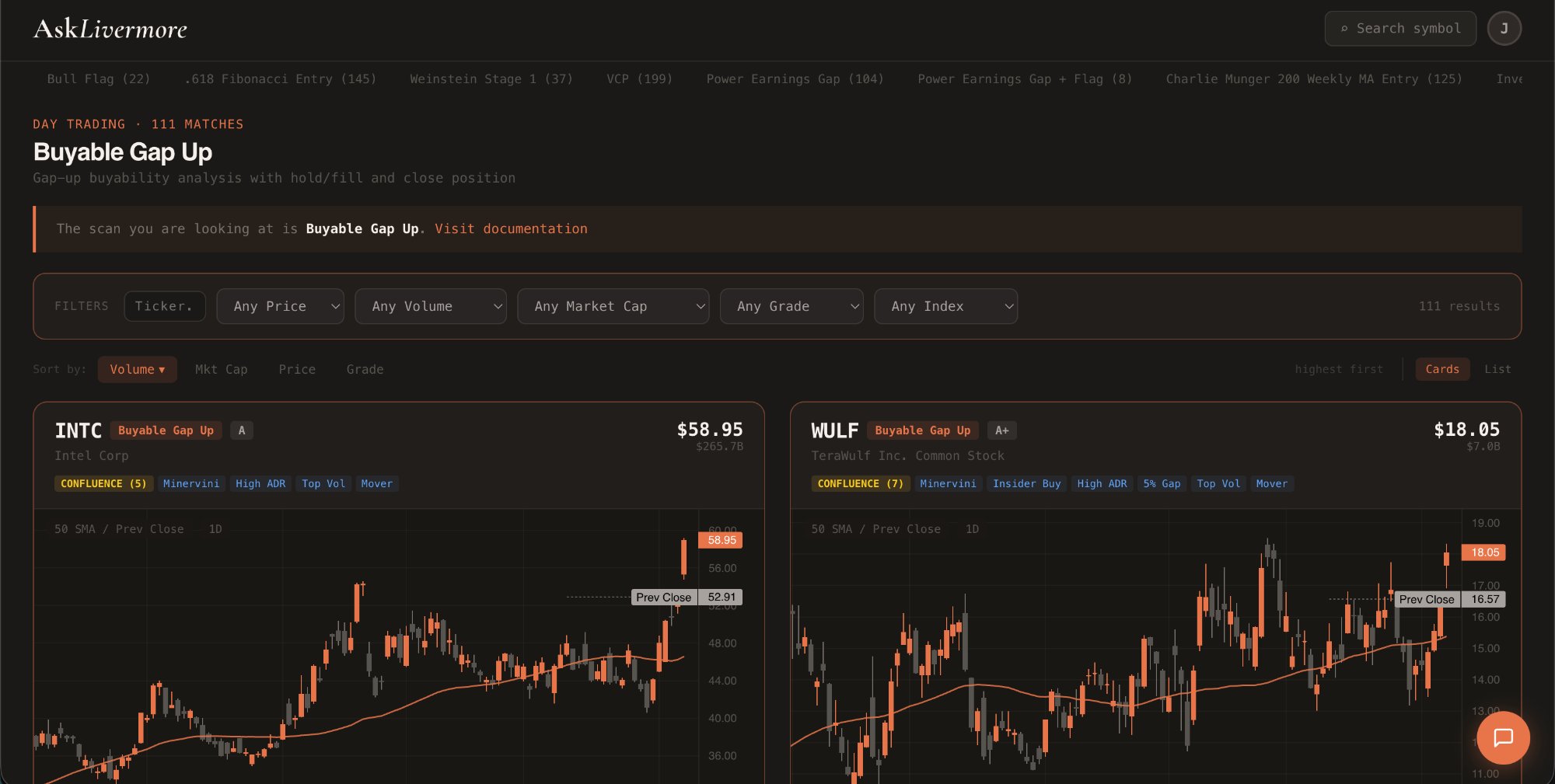
The standout feature separating AskLivermore from competitors is its quality grading system. Each detected pattern receives a grade from A+ down to B based on multiple technical criteria.
A bull flag might earn an A+ grade for its shallow pullback ratio, declining consolidation volume, and strong relative strength. The same pattern type in a different stock might receive a B+ for deeper retracement or weaker volume characteristics.
This grading approach addresses a common scanner problem: pattern overload. Without quality filters, traders get buried in mediocre setups that technically qualify as patterns but lack conviction-level characteristics.
Most competing tools either provide binary results (pattern exists or doesn't) or rely on simple ranking metrics. The nuanced grading system helps traders allocate attention efficiently — especially valuable when markets become more selective about which setups actually work.
| Feature | AskLivermore | DeepVue | FinViz | TradingView |
|---|---|---|---|---|
| Pattern scanners | 48 across 7 categories | ~12 | Filters only | Manual chart review |
| Quality grading | A+ to B scoring | None | None | None |
| Real-time scanning | Every 5 min (day trading) | Daily | Delayed 15 min | Manual |
| Chart overlays | Auto-drawn patterns | None | None | Manual drawing |
| Price | $29/mo ($24/mo annual) | ~$49/mo | $25/mo | $15-60/mo |
| Free tier | Top 6 results per scan | No | Basic filters | Basic charts |
Pricing and Value Proposition
AskLivermore's pricing sits at the accessible end of the scanner spectrum. The free tier provides the top 6 results per scanner — enough to evaluate the tool's effectiveness without commitment. Pro access costs $29 monthly or $290 annually, unlocking full results across all 48 scanners.
Traditional financial data providers typically charge $50-200 monthly for comparable screening capabilities. Premium pattern recognition tools can reach $300+ monthly, positioning themselves as professional-grade solutions.
The value equation depends on trading frequency and capital allocation. For traders running concentrated portfolios who need just a few high-quality setups weekly, the lower price point makes sense. High-frequency traders or those managing larger capital might justify premium tool costs for additional features and data depth.
Scanner Coverage and Categories
AskLivermore organizes its 48 scanners across 7 distinct categories: day trading, swing trading, momentum, earnings, value & growth, pre/post market, and intelligence. This categorization helps traders navigate to relevant setups quickly.
The swing trading category includes classic formations like cup and handles, ascending triangles, and Fibonacci retracements. Momentum scanners focus on continuation patterns and breakout scenarios. Value-oriented scanners incorporate fundamental screening alongside technical patterns.
The intelligence category stands out for its unique approach, including scanners for insider buying, smart money activity, and sector rotation signals.
Most competing scanners focus heavily on either technical patterns or fundamental metrics, but rarely blend both effectively across different trading styles and timeframes.
Update Frequency and Market Coverage
AskLivermore scans over 5,000 NASDAQ and NYSE stocks daily, updating results in real-time during market hours. The coverage includes small-caps through large-caps, though filters allow traders to focus on specific market cap ranges or major indices like the S&P 500, NASDAQ-100, and Dow 30.
Pre-market and post-market scanners update outside regular hours, capturing gap setups and extended-hours momentum. This real-time approach contrasts with some competitors who update once daily or rely on end-of-day data.
The scanning universe of 5,000+ stocks provides adequate coverage for most trading styles without becoming unwieldy. Some institutional-grade tools scan broader universes including international markets and OTC stocks, but the additional complexity rarely benefits individual traders.
User Experience and Learning Curve
The interface prioritizes simplicity over feature density. Each scanner presents results in a clean table format showing ticker, grade, key metrics, and mini-chart previews. Clicking any result opens a detailed chart view with 50-period simple moving average and previous close overlays.
Navigation feels intuitive for traders familiar with basic charting concepts. The learning curve primarily involves understanding what each scanner looks for and how the grading system works. No complex setup or configuration is required.
This contrasts with more comprehensive platforms that offer extensive customization but require significant time investment to use effectively. The streamlined approach works well for traders who want to identify setups quickly rather than build elaborate screening criteria.
Mobile Experience and Accessibility
The web-based platform works across devices without requiring separate mobile apps. Chart viewing and scanner navigation function adequately on smartphones, though detailed analysis benefits from larger screens.
Mobile functionality focuses on essential features: viewing scanner results, checking grades, and basic chart review. Advanced features like custom alerts or portfolio tracking aren't emphasized, keeping the mobile experience focused on core pattern identification.
Filtering and Sorting Capabilities
AskLivermore provides essential filters without overwhelming complexity. Traders can filter by price range, volume, market cap, grade level, and index membership. These core filters handle most common screening needs.
Sorting options include grade, price, volume, and market cap. The grade-first sorting proves most valuable, surfacing highest-quality setups regardless of other metrics.
More advanced platforms offer dozens of filter criteria and complex boolean logic. For traders who need extensive customization, these limitations might feel restrictive. But the focused filter set eliminates decision paralysis for traders who simply want quality setups without extensive configuration.
Integration with Trading Platforms
AskLivermore functions as a discovery tool rather than a complete trading platform. Results link to major brokerages and charting platforms, but direct trading isn't supported. This approach keeps the tool focused on its core strength: pattern identification.
Some competing platforms integrate order entry, position management, and portfolio tracking. The all-in-one approach appeals to traders who prefer consolidated workflows, though it often comes with higher complexity and cost.
Best Use Cases and Trading Styles
AskLivermore works best for swing traders and position traders who focus on pattern-based entries. The grading system particularly benefits traders who run concentrated portfolios and need high-conviction setups rather than broad diversification.
Day traders can use the momentum and gap scanners, though the tool doesn't emphasize intraday patterns or real-time alerts that pure day trading requires. The daily update frequency suits swing trading timeframes better than scalping or high-frequency approaches.
Value investors might appreciate scanners that blend fundamental criteria with technical timing. Growth investors can focus on momentum scanners and breakout patterns.
Limitations and Considerations
As a newer entrant in the scanner space, AskLivermore lacks the extensive backtesting data and community features that established platforms provide. The tool doesn't offer historical performance statistics for its patterns or detailed success rate documentation.
The 48 scanner count, while comprehensive, falls short of platforms offering hundreds of screening combinations. Traders who need highly specialized or exotic pattern detection might find the selection limiting.
The focus on US equities excludes international markets, forex, and cryptocurrency scanning. Traders working across multiple asset classes need additional tools to cover their full universe.
Competitive Assessment
The pattern recognition space includes established players like ChartMill, FinViz, and various institutional platforms. Each offers different strengths: ChartMill excels at European market coverage, FinViz provides extensive fundamental screening alongside technical patterns, while institutional tools offer comprehensive backtesting and portfolio integration.
AskLivermore's positioning as an affordable, focused pattern detector fills a specific niche. It competes more on simplicity and value than on comprehensive feature sets or extensive market coverage.
For traders evaluating alternatives, the choice often comes down to complexity tolerance and specific needs. Those wanting extensive customization and advanced features might prefer more comprehensive platforms. Traders seeking straightforward pattern identification with quality scoring find AskLivermore's approach more suitable.
For deeper comparisons with specific competitors, see our analysis of AskLivermore vs DeepVue and our guide to the best stock scanner for swing traders.
The Verdict: AskLivermore Review for 2026 Trading
AskLivermore delivers on its core promise: identifying quality chart patterns with clear grading across a reasonable scanning universe. The $29 monthly cost provides solid value for traders who focus on pattern-based setups and don't need extensive bells and whistles.
The tool works best as part of a broader trading toolkit rather than a standalone solution. Traders still need quality charting software, news sources, and execution platforms. But for the specific task of pattern discovery, AskLivermore provides efficient results without overwhelming complexity.
The grading system represents genuine innovation in the scanner space. Rather than dumping every technical pattern match, the quality scoring helps traders focus on setups with better statistical characteristics. This proves especially valuable during selective market periods when only the strongest setups generate profits.
The honest assessment: it's a focused tool that does pattern detection well at a reasonable price. Not revolutionary, but genuinely useful for pattern-oriented traders who value simplicity and quality scoring over feature complexity. The main drawbacks include limited backtesting data and US-only market coverage, but these limitations don't undermine the core value proposition for most swing traders.
Ready to evaluate the patterns yourself? Check out the live scanner results and see how the grading system works with current market setups.
AskLivermore scans 5,000+ stocks daily and scores every setup from A+ to B.
View Bull Flag results →