AskLivermore vs DeepVue: Which Stock Scanner Delivers Better Pattern Recognition in 2026?
Traders waste hours sifting through mediocre setups because most scanners throw quantity at them instead of quality. The difference between finding 500 random stocks above their 50-day moving average versus discovering 23 high-grade bull flags with proper volume characteristics can make or break your trading results.
The AskLivermore vs DeepVue stock scanner comparison boils down to philosophy: do you want a traditional screener that filters by metrics, or a pattern recognition engine that grades setup quality? Both tools serve traders, but they approach market scanning from fundamentally different angles.
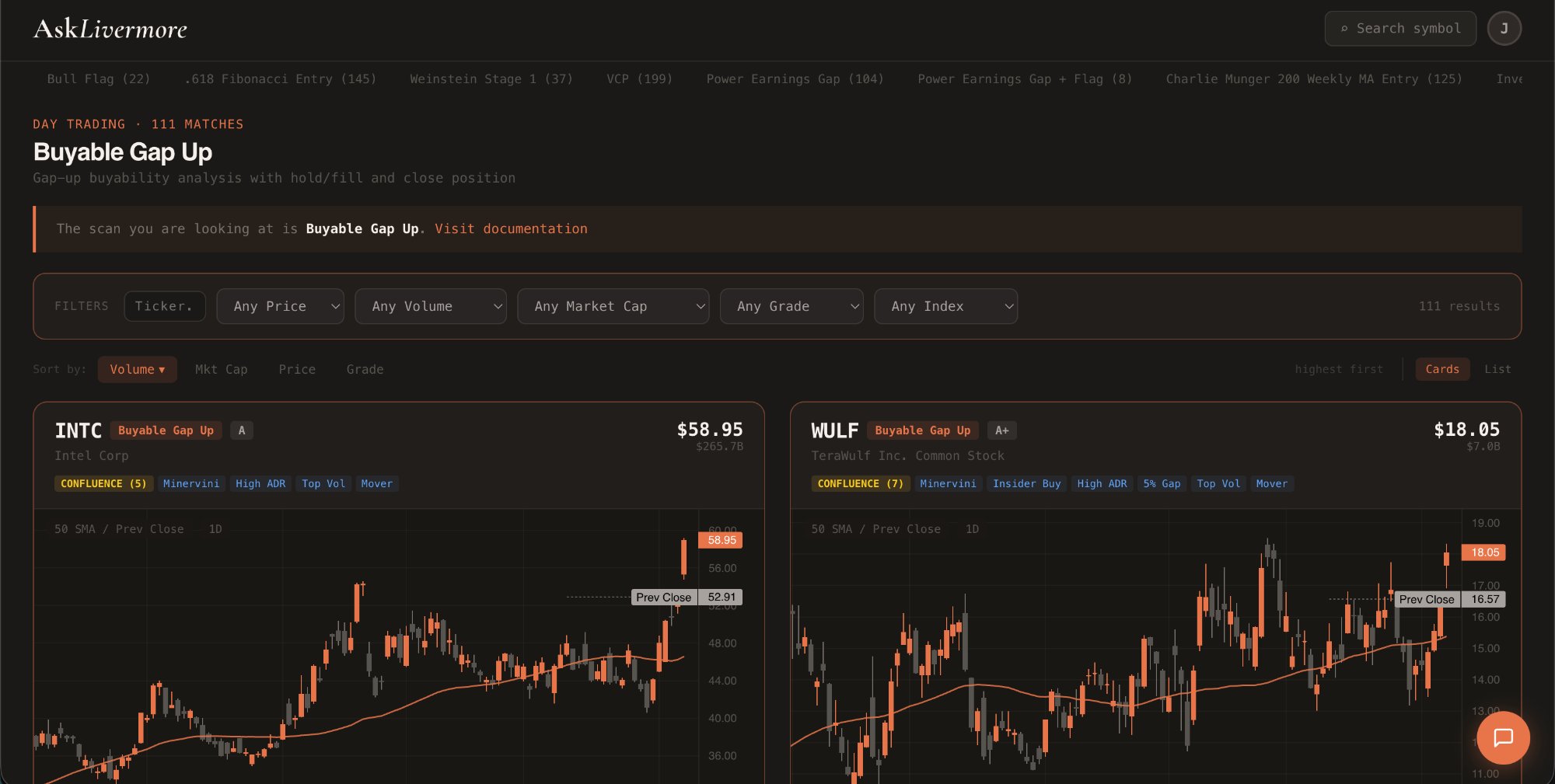
DeepVue built its reputation as a comprehensive market analysis platform with robust fundamental screening capabilities. AskLivermore entered the space as a pure pattern scanner, focusing exclusively on technical setups with its A+ to B grading system across 48 specialized scanners.
Pattern Detection: Metrics vs. Visual Recognition
DeepVue excels at fundamental screening — finding stocks that meet specific financial criteria like P/E ratios, revenue growth, or debt-to-equity thresholds. Traders can build complex filters combining dozens of fundamental and technical metrics. The platform's strength lies in its database depth and screening flexibility.
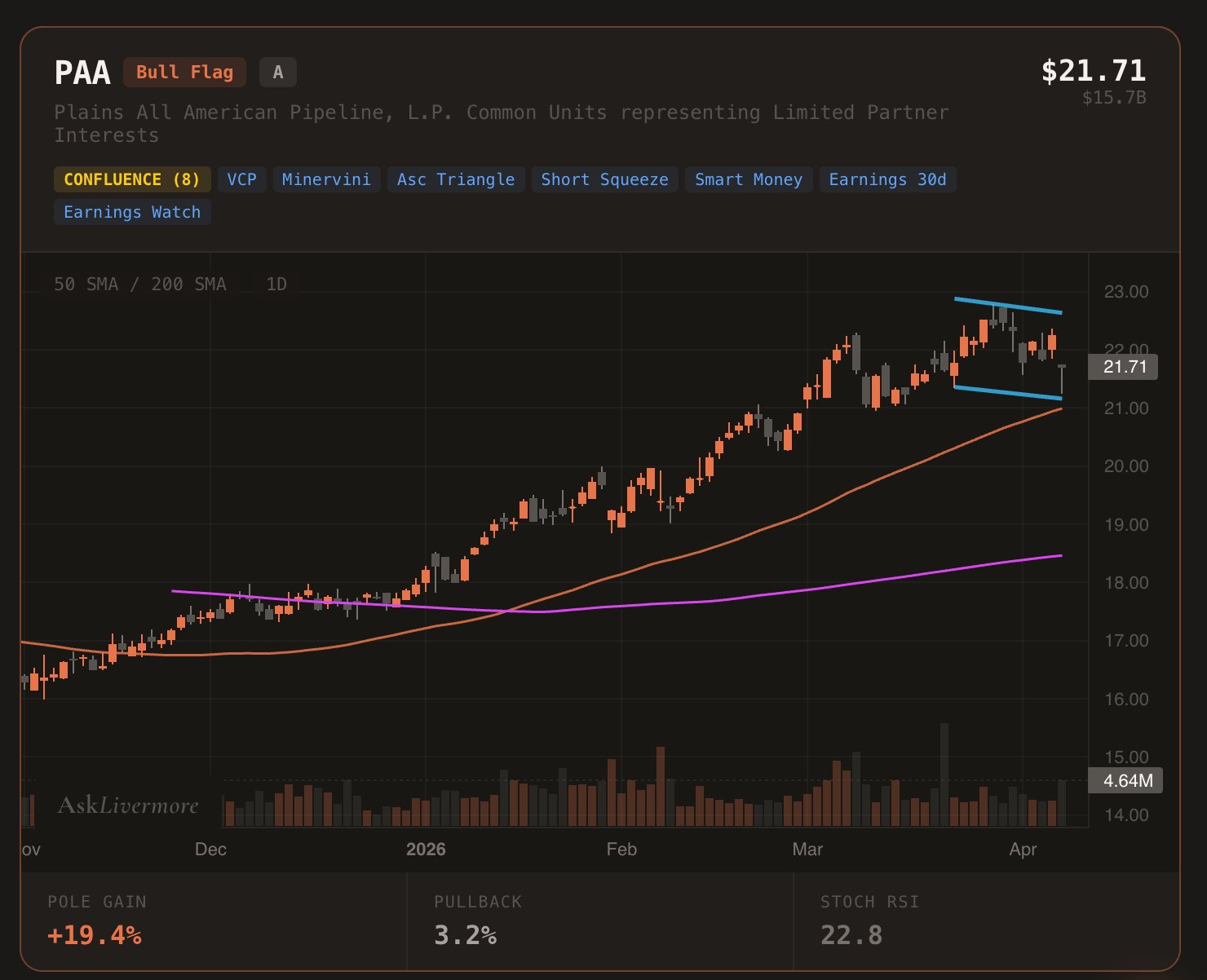
AskLivermore takes a different approach entirely, applying algorithmic chart pattern recognition. Instead of filtering by individual metrics, it identifies complete chart patterns using algorithmic recognition. The bull flag scanner, built on the classic bull flag pattern, doesn't just look for stocks above moving averages — it detects the pole formation, consolidation structure, and volume characteristics that define a proper bull flag setup.
This philosophical difference matters more than most traders realize. Traditional screeners excel at finding stocks that meet your criteria, but they can't tell you whether those criteria form a tradeable pattern. Pattern scanners reverse-engineer the process: they start with proven setups and surface the best examples.
The learning curve reflects this difference. DeepVue requires traders to understand which metrics matter and how to combine them effectively. AskLivermore requires pattern recognition knowledge — understanding why a VCP setup with three tight weekly closes outperforms one with erratic volatility.
Pricing: Value Proposition Analysis
Cost becomes a decisive factor when comparing scanning platforms. Traditional comprehensive screeners typically charge $50-200 per month for professional features. Premium platforms can exceed $300 monthly for advanced capabilities.
AskLivermore positions itself differently at $29 monthly or $290 annually. The free tier provides access to the top 6 results per scanner — enough for casual traders to evaluate pattern quality before upgrading. This pricing strategy makes pattern scanning accessible to retail traders who previously couldn't justify expensive screening platforms.
The value equation depends on trading style. Fundamental analysts who need extensive financial data might find traditional platforms worth their higher cost. Pattern traders focused on technical setups often discover they're paying for features they never use.
Consider frequency of use. Traders who scan daily benefit more from comprehensive access, while weekend warriors might find the free tier sufficient for weekly pattern hunting.
| Feature | AskLivermore | DeepVue | FinViz | TradingView | |---------|-------------|---------|--------|-------------| | Pattern scanners | 48 across 7 categories | ~12 | Filters only | Manual chart review | | Quality grading | A+ to B scoring | None | None | None | | Real-time scanning | Every 5 min (day trading) | Daily | Delayed 15 min | Manual | | Chart overlays | Auto-drawn patterns | None | None | Manual drawing | | Price | $29/mo ($24/mo annual) | ~$49/mo | $25/mo | $15-60/mo | | Free tier | Top 6 results per scan | No | Basic filters | Basic charts |
Speed and Update Frequency
Real-time data becomes crucial during market hours, especially for day trading setups. AskLivermore scans 5,000+ NASDAQ and NYSE stocks continuously, updating pattern grades as price action develops. The pre-market movers and post-market scanners capture momentum before and after regular hours.
Traditional screeners often update every 15-20 minutes during market hours. This delay can matter significantly when trading volatile patterns or momentum plays. By the time a screener flags a breakout, the optimal entry might have passed.
Pattern recognition requires more computational power than basic metric filtering. AskLivermore's focus on technical patterns allows for specialized algorithms that can process chart formations quickly. Broader platforms must balance computational resources across multiple features, potentially sacrificing speed in any single area.
Mobile Experience and Accessibility
Mobile trading continues growing, making scanner accessibility critical. Traders need to check setups during commutes, lunch breaks, or while away from their primary trading stations.
Most traditional screening platforms were built for desktop use, with mobile apps feeling like afterthoughts. Complex filter interfaces don't translate well to small screens, making mobile screening frustrating.
AskLivermore's simplified approach works better on mobile devices. Instead of building complex filters, traders browse pre-configured scanners organized by category. The grading system makes it easy to prioritize setups even on a phone screen — A+ grades get attention first.
The visual emphasis also suits mobile trading. Pattern recognition relies on chart visualization, which mobile devices handle well. Fundamental analysis requires comparing multiple data points simultaneously, which becomes cumbersome on smaller screens.
Quality Scoring: The A+ to B Grading System
Perhaps the most significant difference lies in quality assessment. Traditional scanners return everything that meets your criteria without ranking setup quality. Traders must manually evaluate each result to determine which deserve attention.
AskLivermore's A+ to B grading system changes this dynamic entirely. The algorithm evaluates multiple pattern characteristics — volume behavior, consolidation tightness, breakout strength — and assigns quality scores. An A+ result from the VCP scanner or cup and handle meets stricter criteria than a B+ version of the same pattern.
This approach addresses a common trading problem: too many mediocre setups dilute focus. Bulkowski's research across decades of S&P 500 data shows that pattern quality significantly impacts success rates. A properly formed bull flag with declining volume during consolidation outperforms sloppy versions by substantial margins.
The grading system has limitations — it's algorithmic interpretation of visual patterns that experienced traders might assess differently. However, it provides a starting point for prioritization that traditional screeners lack entirely.
Filtering and Customization Options
DeepVue offers extensive customization capabilities. Traders can build complex screens combining fundamental metrics, technical indicators, and market data. The platform accommodates virtually any screening strategy traders can conceive.
AskLivermore provides more focused filtering options: price range, volume thresholds, market cap, grade level, and index membership (S&P 500, Nasdaq-100, Dow 30). These filters work within each scanner rather than replacing the pattern recognition engine.
The customization difference reflects each platform's target user. Quantitative traders who build systematic strategies need extensive filtering options. Pattern traders often prefer fewer, more relevant filters that don't interfere with setup identification.
Some traders appreciate DeepVue's flexibility for testing screening ideas. Others find the options overwhelming, leading to over-optimization or analysis paralysis.
Learning Curve and User Experience
Getting productive with any scanning platform requires learning its interface and capabilities. DeepVue's comprehensive feature set creates a steeper learning curve — new users must understand both the platform mechanics and the underlying market concepts.
AskLivermore simplifies the initial experience by organizing scanners into logical categories: day trading, swing trading, momentum plays, earnings strategies, value and growth opportunities, and market intelligence. New users can immediately access proven patterns without building custom screens.
The educational component differs significantly. Traditional screeners assume users understand which metrics matter for their strategies. Pattern scanners assume users understand chart formations and their statistical characteristics.
Both assumptions can be problematic. Beginning traders might struggle with either approach, but pattern recognition often feels more intuitive than fundamental analysis to visually-oriented learners.
Community and Support
Established platforms typically offer larger user communities, educational resources, and customer support infrastructure. DeepVue benefits from years of user feedback and feature development based on trader needs.
AskLivermore enters as a newer platform with a smaller but growing community. The focused approach means fewer features to support, potentially enabling more responsive development and user assistance. However, the knowledge base and community resources remain limited compared to established competitors.
Community matters for learning and troubleshooting. Experienced users often provide insights that official documentation misses. Newer platforms must build this organic support network over time.
Best Use Cases for Each Platform
The AskLivermore vs DeepVue stock scanner comparison ultimately depends on trading approach and priorities. DeepVue suits traders who need comprehensive market analysis, extensive customization, and fundamental screening capabilities. It works well for systematic strategies, sector rotation plays, and fundamental analysis integration.
AskLivermore excels for pattern traders focused on technical setups, momentum plays, and visual chart analysis. The grading system particularly benefits traders who want quality over quantity in their daily scanning routine. The best DeepVue alternative stock scanners analysis shows how specialized tools can outperform general-purpose platforms for specific use cases.
Price-conscious traders appreciate AskLivermore's accessible pricing structure. The free tier provides genuine value, while the pro subscription costs significantly less than comprehensive screening platforms.
Time-constrained traders benefit from pattern recognition efficiency. Instead of building custom screens and evaluating hundreds of results, they can quickly browse high-grade setups across multiple pattern types.
The Verdict: Pattern Focus vs. Comprehensive Analysis
The decision between comprehensive screening and specialized pattern recognition reflects broader trading philosophy choices. DeepVue wins for traders who need extensive fundamental data, complex screening capabilities, and don't mind paying premium prices for comprehensive features.
AskLivermore takes the edge for pattern-focused traders who prioritize setup quality over screening flexibility. The $29 monthly price point and quality grading system make it particularly attractive for retail traders focused on technical analysis.
Neither platform is perfect. DeepVue's complexity can overwhelm pattern traders, while AskLivermore's specialization might frustrate traders who need fundamental screening capabilities. The choice depends on matching tool capabilities with your actual trading behavior rather than theoretical requirements.
Consider your current scanning process. Do you spend more time building screens or evaluating results? Are you looking for setup ideas or confirmation of existing strategies? Your answers point toward the more suitable platform type.
For more on the swing-trader use case specifically, see pattern vs traditional screening for swing traders. Ready to experience pattern-focused scanning with quality grading? Explore AskLivermore's 48 specialized scanners and see how the A+ to B system can streamline your daily market preparation. Start scanning now with free access to top-tier setups across all pattern categories.
AskLivermore scans 5,000+ stocks daily and scores every setup from A+ to B.
View Bull Flag results →